
A car accident disrupts everything at once. You are dealing with pain, a damaged vehicle, missed work, and a stream of phone calls from insurance companies. In the middle of all that, it is easy to make decisions that seem harmless in the moment. Some of them weaken your claim later.
Georgia is an at fault state. The driver who caused the crash is responsible for the resulting injuries and damage, usually through their liability insurance. That system puts the burden on you to prove what happened, who was responsible, and how badly you were hurt. Insurance companies know the rules well and are experienced at finding reasons to pay less. Most of the mistakes described below are mistakes because they hand the insurer exactly what it is looking for.
This article covers seven common errors that hurt car accident claims in Georgia. It explains the state laws that make them costly and describes what to do instead.
1. Not Reporting the Crash or Getting a Police Report
Some drivers agree at the scene to handle things privately, especially when the damage looks minor and everyone seems fine. This is one of the most consequential mistakes you can make.
Georgia law requires drivers to report accidents in certain circumstances. Under O.C.G.A. § 40-6-273, a driver involved in a crash resulting in injury, death, or apparent property damage of $500 or more must report it immediately. The report can go to local police, the sheriff’s office, or the Georgia State Patrol. Nearly every collision involving a modern vehicle exceeds $500 in damage, so this requirement applies to almost every crash.
Beyond the legal obligation, the police report is the foundation of an insurance claim. The Georgia Motor Vehicle Crash Report prepared by the responding officer documents the date, time, location, vehicles, drivers, and insurance information. It also records witness names, road conditions, and the officer’s observations about how the crash occurred. Most reports include a diagram and note any citations issued. Insurance adjusters rely on it heavily, and without one, the claim becomes your word against the other driver’s.
Drivers who agree to skip the report frequently discover that the other party changes their story once they talk to their own insurer. The friendly driver who admitted fault at the scene now claims you pulled out in front of them. With no report and no independent record, proving otherwise is difficult.
Call the police after any collision, even one that appears minor. Wait for the officer, give an accurate account, and get the report number before you leave. You can obtain a copy of the report from the responding agency. Many Georgia agencies also make reports available online for a fee.
2. Waiting to See a Doctor
Adrenaline masks pain. Many people feel fine immediately after a crash and decide to wait and see how they feel in a few days. By the time the neck stiffness, headaches, or back pain set in, they have created a gap. The insurance company will use it against them.
From a medical standpoint, delayed symptoms are common. Soft tissue injuries such as whiplash typically worsen over the first several days as inflammation develops. Concussion symptoms may not become obvious until you try to return to normal activity. Internal injuries can be silent at first and dangerous later.
From a legal standpoint, the timing of your first medical visit is one of the first things an adjuster examines. A delay of a week or more invites the argument that you were not really hurt. It also opens the door to the claim that something else caused the injury in the meantime. The longer the gap, the stronger that argument becomes.
Get evaluated within a day or two of the accident, even if you feel fine. Tell the provider you were in a car accident, give the date, and describe every symptom. This creates the first medical record connecting your condition to the crash. Then follow the treatment plan. Missed appointments, skipped physical therapy, and long breaks between visits all appear in the claim file. Each one reduces the value of the claim.
3. Saying Too Much to the Other Driver’s Insurance Company
Within a day or two of the accident, you will likely receive a call from the other driver’s insurance company. The adjuster will be polite and will ask you to give a recorded statement about what happened. They may say it is a routine step needed to process your claim.
You are not required to give a recorded statement to the other driver’s insurer. That adjuster works for the company that will have to pay your claim. The purpose of the statement is to gather information that can be used to reduce or deny it. Questions are often framed to draw out admissions. You may be asked whether you were in a hurry, whether you saw the other car, or how fast you were going. Expect questions about whether you have ever had neck or back problems before.
Georgia’s evidence rules make this especially risky. A statement made by a party to a case and offered against that party is generally admissible. It does not face the hearsay barriers that apply to many other out of court statements. Whatever you say on that recording can be played back later.
Apologies are a related problem. Many people say sorry at the scene out of simple courtesy, even when they did nothing wrong. Insurers and defense attorneys treat an apology as an acknowledgment of fault. Be polite at the scene, check on the other people involved, and exchange information, but do not discuss who caused the crash.
Under Georgia’s modified comparative negligence rule, found at O.C.G.A. § 51-12-33, your recovery is reduced by your percentage of fault. You recover nothing if you are found fifty percent or more at fault. Every admission that shifts a few percentage points of blame onto you costs real money. An offhand remark can be the difference between a full recovery and no recovery at all.
Decline the recorded statement, provide only basic contact and insurance information, and refer the adjuster to your attorney if you have one.
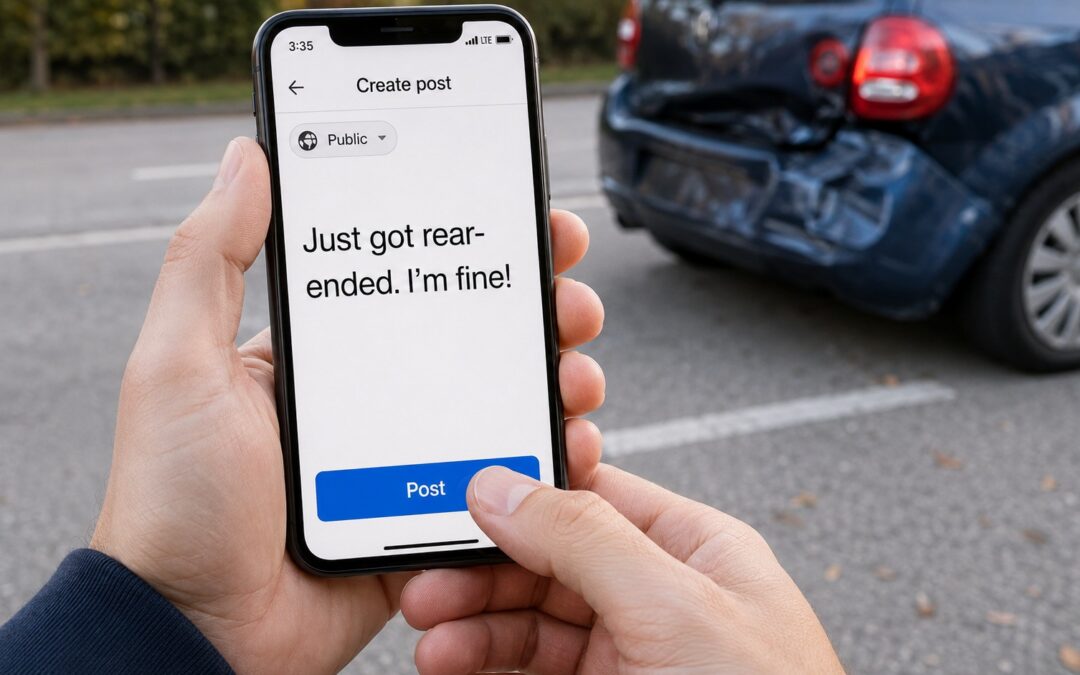
4. Posting About the Accident or Your Recovery Online
Social media has become a standard investigative tool for insurance companies. Adjusters and defense attorneys review public profiles as a matter of routine. In litigation they can request content from private accounts through Georgia’s discovery rules when it is relevant to the case.
The damage comes in several forms. Photos of you at a cookout, on a hike, or lifting a child contradict claims about physical limitations. Cheerful updates undermine claims for pain, suffering, and emotional distress. Comments about the crash, such as saying you are fine or that you did not see the other car, become admissions. Even posts by friends who tag you or comment on your activities can end up in the claim file.
Deleting content after an accident creates a separate problem. Georgia law recognizes the doctrine of spoliation. A party who destroys relevant evidence after litigation is reasonably foreseeable can face serious sanctions. Courts may instruct the jury that the deleted material is presumed to have been unfavorable. Removing a post that looked bad can make the situation worse than the post itself.
The safest approach is to stop posting about anything related to the accident, your injuries, or your treatment. Hold off on posting about daily activities as well until the claim is resolved. Set accounts to private, decline friend requests from people you do not know, and ask family and friends not to tag you. Preserve existing content rather than deleting it, and tell your attorney about anything that concerns you.
5. Accepting the First Settlement Offer
Insurance companies sometimes make settlement offers quickly, in some cases within days of the crash. The offer may seem generous compared to the bills you have received so far. Accepting it feels like a way to put the whole thing behind you.
Early offers are almost always low. They are made before the full extent of your injuries is known and before you have completed treatment. Nobody can accurately estimate future medical costs or lost income at that stage. The insurer is counting on the fact that you do not yet know what your claim is worth.
Accepting a settlement requires signing a release. A release ends your claim permanently. Suppose your back injury turns out to need surgery six months later, or a concussion produces lasting symptoms. You cannot reopen the claim or ask for more. The release is final regardless of what you learn afterward.
Georgia allows recovery for a range of damages in a car accident claim. These include medical expenses, future medical care, lost wages, reduced earning capacity, property damage, and pain and suffering. Pain and suffering is determined by the enlightened conscience of the jury rather than a fixed formula. A quick offer rarely accounts for all of these categories.
Do not accept any offer until your doctors can reasonably predict the long term outcome of your injuries. Never sign a release without having an attorney review it.
6. Missing a Deadline
Georgia sets strict time limits on car accident claims. Missing one can eliminate your right to recover entirely, no matter how strong the underlying case.
The general statute of limitations for personal injury claims in Georgia is two years from the date of the accident, under O.C.G.A. § 9-3-33. Claims for property damage, such as the cost of repairing or replacing your vehicle, carry a four year limit. That rule is found at O.C.G.A. § 9-3-31 and § 9-3-32. If you have not filed a lawsuit before the deadline passes, the court will dismiss the case.
Two years sounds like a long time, but it passes quickly when treatment is ongoing and negotiations drag on. Insurers are aware of the deadline and sometimes slow the process as it approaches. A claimant who has not filed suit loses all leverage the day it expires.
Some claims have much shorter deadlines. If the crash involved a vehicle owned by a city, county, or state agency, a different rule applies. Georgia requires a formal written ante litem notice before a lawsuit can be filed. Claims against a city must be presented within six months under O.C.G.A. § 36-33-5. County claims must be presented within twelve months under O.C.G.A. § 36-11-1. For the State of Georgia, the Georgia Tort Claims Act applies. It requires notice within twelve months under O.C.G.A. § 50-21-26. These notices have specific content requirements, and a defective notice can end the claim.
Certain circumstances can extend the deadline. The limitations period is tolled for minors until they reach eighteen. Georgia also has a tolling provision at O.C.G.A. § 9-3-99 for victims of crimes. It can pause the deadline while a related prosecution is pending, for up to six years. Courts have applied this provision to some traffic offenses. These exceptions are technical and should never be relied on without an attorney’s review.
Mark the two year date on your calendar the week of the accident. Consult an attorney early if there is any possibility that a government vehicle or employee was involved.
7. Overlooking Your Own Insurance Coverage
Many drivers focus entirely on the other driver’s insurance and never examine their own policy. That oversight can leave significant money on the table, especially when the at fault driver is uninsured or carries only minimum coverage.
Georgia requires drivers to carry minimum liability limits of $25,000 per person and $50,000 per accident for bodily injury. The property damage minimum is $25,000. Those amounts are quickly exhausted by a serious injury. A single emergency room visit with imaging can consume a large portion of a $25,000 limit. Any hospital stay or surgery will exceed it.
Uninsured and underinsured motorist coverage fills that gap. Under O.C.G.A. § 33-7-11, Georgia insurers must offer this coverage, and it can only be rejected in writing. Many drivers have it without realizing it. Georgia also distinguishes between two types of underinsured motorist coverage. Added on coverage stacks on top of the at fault driver’s liability limits. Reduced by coverage subtracts the at fault driver’s limits from your own. Which type you have makes a significant difference in a serious injury case. Review your declarations page to find out.
Medical payments coverage, often called MedPay, is another optional coverage that pays medical expenses regardless of fault, up to the policy limit. It can cover copays, deductibles, and out of pocket costs while the liability claim is pending.
Your own policy also imposes obligations. Most policies require prompt notice of any accident and cooperation with the insurer’s investigation. Failing to notify your own carrier, or waiting too long, can jeopardize coverage under your own policy. That is true even when the other driver is clearly at fault. Report the accident to your insurer promptly, even if you do not expect to make a claim against your own coverage.
A Note on Recent Changes to Georgia Law
Georgia enacted significant tort reform legislation in 2025 through Senate Bill 68. The law changed several rules that affect car accident cases. These include how medical expenses are presented to juries and the admissibility of evidence regarding seat belt use. Some provisions apply differently depending on when a case was filed. These changes are recent and continue to be interpreted by the courts. Anyone with a pending or potential claim should ask an attorney how the current law applies to their situation.
What to Do Instead
Avoiding the seven mistakes above comes down to a short list of habits.
Call the police after every collision and get the report. See a doctor within a day or two and follow through with treatment. Give the other driver’s insurer only basic information and decline the recorded statement. Stay off social media and preserve what is already there. Refuse early settlement offers until your medical picture is clear. Know your deadlines, especially if a government vehicle was involved. Review your own policy and report the accident to your own carrier.
One more step ties all of these together. Speak with a personal injury attorney early, before you have given a statement, accepted an offer, or let a deadline slip. Most Georgia injury attorneys offer free consultations and work on a contingency fee basis. No fee is owed unless the case results in a recovery. An early conversation costs nothing and prevents the errors that are hardest to undo.
Conclusion
Car accident claims in Georgia are governed by specific rules on fault, deadlines, evidence, and insurance coverage. Insurance companies understand those rules and use them to minimize what they pay. The seven mistakes in this article are common precisely because they feel reasonable in the moment. Skipping the police report avoids hassle, and waiting on the doctor seems sensible. Being polite to the adjuster feels right, and a quick settlement offers relief.
Each of those choices carries a cost that may not be obvious until it is too late to correct. Understanding the rules before you act, and getting professional guidance when the stakes are high, gives you the best chance of a fair outcome.
This article provides general information about Georgia law and is not legal advice for any specific situation. If you have been injured in a car accident in Georgia, consult an attorney about the facts of your case.